
Beaufort County Court Records After a Jail Arrest
When someone is arrested in Beaufort County and booked into the Beaufort County Detention Center, the jail record is usually the first public source. The official roster can list the arresting agency, arresting officer, booking number, statute or charge code, warrant or case number, charge label, bond amount, and court. Those fields are useful starting points, but the jail charge is not the final court record. The formal record is tracked through the South Carolina Judicial Branch Public Index, court rosters, the Beaufort County Clerk of Court, the relevant Magistrate or Municipal Court, and the Fourteenth Judicial Circuit Solicitor when the case is in General Sessions.
Beaufort County is served by Sheriff P.J. Tanner for law-enforcement operations, while the detention center is published under Beaufort County Government. The jail address is 100 Ribaut Rd, Beaufort, SC 29902, and the detention center phone is (843) 255-5200. Use jail inmate records for the custody side and current roster feeds. Use jail mugshots for booking photos and recent booking-photo records. Use court records after an arrest for the case side: court routing, prosecutor action, bond hearings, charge status, scheduled appearances, dispositions, and certified copies.
How to Find Beaufort County Court Records After an Arrest
The most direct public case-search channel is the South Carolina Judicial Branch Beaufort County Public Index. The county research also confirmed the Beaufort County court rosters for scheduled appearances. If a jail roster charge line lists General Sessions Court, Beaufort County Magistrate, Bluffton Magistrate Court, Beaufort City Municipal Court, or Port Royal Municipal Court, treat that court field as a routing clue. Blank court fields happen, so use the case number, warrant number, charge text, arresting agency, and booking date together rather than relying on a single field.
- Open the Beaufort County Public Index in a normal browser and select the Beaufort court search path.
- Search by defendant name first, then try a roster case or warrant number such as a value beginning with 2026A071 or 2026A072 when one appears.
- Open each possible case and compare the defendant name, filing date, charge description, statute, and court division against the jail record.
- Check the charge status, bond history, hearing dates, disposition, and whether the matter is in General Sessions, Magistrate Court, or a municipal court.
- Use the court roster link for upcoming appearances, especially when the Public Index confirms a case but the reader needs a scheduled court date.
The Public Index is the formal court lookup. The jail roster is the quickest way to see arrest charges and custody status. The Beaufort County FOIA portal at JustFOIA is the fallback for booking or county records not shown online. For certified court copies, the appropriate court office remains the better channel because FOIA does not turn an unofficial screenshot into a certified court document.
The court search page captured for this project is the official Beaufort County Public Index source: South Carolina Judicial Branch Beaufort County case search portal.
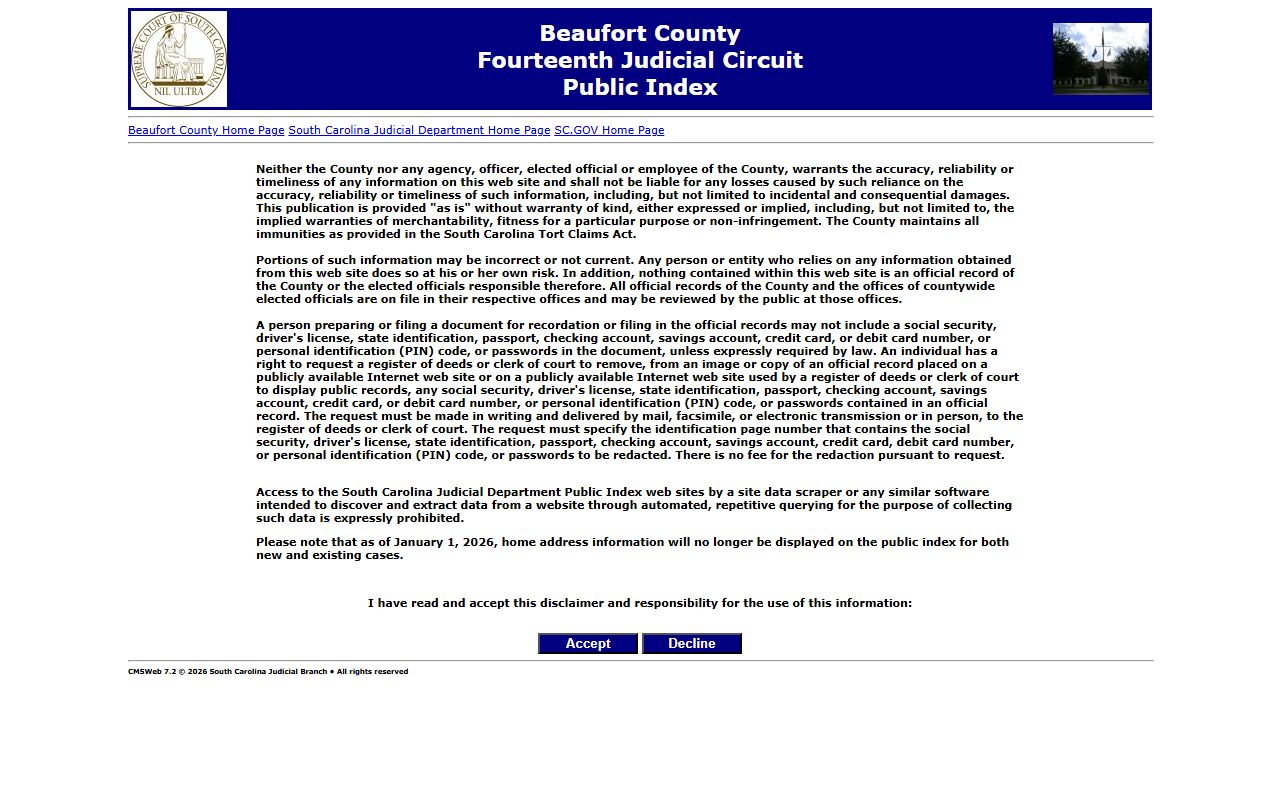
The Public Index screenshot is useful because it shows the court-record side of the search, separate from the jail roster feeds hosted by the county detention system.
How Charges Get Filed After an Arrest: Complaint, Information, and Indictment
The arrest creates an intake event at the detention center, but the case becomes a court record through a charging process. In Beaufort County, lower-level matters may remain in Magistrate Court or municipal court. Serious criminal cases move through General Sessions, where the Fourteenth Judicial Circuit Solicitor prosecutes Beaufort County cases. South Carolina uses Solicitors rather than District Attorneys. The official prosecutor site is scsolicitor14.org, and the current Solicitor is Duffie Stone. The office serves Allendale, Beaufort, Colleton, Hampton, and Jasper counties.
Booking charges can change after prosecutorial review. A charge may be amended, reduced, dismissed, presented differently in General Sessions, or separated into more than one case. That is why court records after an arrest should be checked by both name and case number. A single Beaufort County booking may show General Sessions plus municipal or magistrate lines, and each line may need a separate court check.
| Complaint | Information | Indictment | |
|---|---|---|---|
| Filed By | Officer or prosecutor, depending on the matter | Prosecutor | Grand jury process |
| Common For | Initial criminal process, warrants, misdemeanors, traffic, and lower-court charges | Prosecutor-filed formal charges where allowed by procedure | Serious felony matters handled in circuit criminal court |
| Starts | The first court case or warrant-linked court process | The prosecutor's formal case filing | A General Sessions prosecution after grand-jury action |
| Beaufort Search Clue | Magistrate or municipal court fields, warrant numbers, ticket-like values | Solicitor and General Sessions records | General Sessions Court records and court rosters |
Charge Status in Court Records After an Arrest
Charge status explains what happened after the initial booking. The jail roster may show an arrest charge, but the court record may later show a different charge label, an added count, a dismissed count, a pending hearing, or a final disposition. Beaufort County roster examples include court values such as General Sessions Court, Beaufort County Magistrate, Bluffton Magistrate Court, Port Royal Municipal Court, and Beaufort City Municipal Court. The court field matters because a status update can appear in one court system before another.
| Status | What It Means |
|---|---|
| Pending | The case is still open. Hearings, bond conditions, prosecutor review, or court action may remain. |
| Amended / Reduced | The prosecutor or court changed the charge from the booking label, often after review, plea negotiation, or legal screening. |
| Dismissed | The court record shows that the charge was not carried forward to conviction. Always check whether other charges remain. |
| Nolle Prosequi | The prosecutor declined to continue that charge. The arrest record may still exist unless an expungement or other clearing process applies. |
| Disposed | The case has a recorded outcome, such as plea, verdict, dismissal, or other final court action. |
Bond and Release After an Arrest
Beaufort County roster records publish a bond amount per offense in the bond field. Research examples included amounts such as 0.00, 1087.50, 5000.00, 15000.00, 25000.00, 50000.00, 100000.00, and 150000.00. These amounts are informational, not a promise that release is available. A person can have a bond on one charge and a no-bond hold, detainer, or other-agency hold on another line. ICE Hold lines appeared in recent booking and release records, which means a local bond amount may not fully answer the release question.
The county rules page says inmates charged with a crime should normally be seen by a judge within 24 hours. At first appearance, the judicial officer advises rights, addresses bond, and starts the appointed-counsel application process. Victim-notification attempts may affect timing. The official detention rules page did not publish a complete bond-payment counter procedure, accepted payment methods, or bondsman policy, so call the Beaufort County Detention Center at (843) 255-5200 before traveling to post bond.
| Bond Type | How It Works |
|---|---|
| Cash Bond | Money is deposited with the court or jail as security for appearance, if that payment channel is accepted for the charge. |
| Surety Bond | A licensed bondsman posts bond for a fee and becomes responsible for the defendant's appearance. |
| PR / Own Recognizance | Release is based on a promise to appear and follow conditions rather than a full cash deposit. |
| Property Bond | Property may secure the bond if accepted through the court process. |
| No-Bond Hold | The person remains in custody because bond is denied, not yet set, or blocked by another hold. |
Warrants That Lead to an Arrest
No official Beaufort County Sheriff public active-warrant search page was located in the research. The best official warrant clues are often inside the county jail roster. The warrant or case field can carry a warrant number, ticket number, court case number, municipal bench warrant label, or a combined value such as a warrant number plus a case number. If the person is already booked, start with the roster charge lines and court field, then search the Beaufort Public Index when the number resembles a court case.
An arrest warrant authorizes an arrest on a charge. A bench warrant is issued by a judge, often for failure to appear or another court-order issue. A search warrant authorizes a search and may not create a jail booking by itself. A fugitive or other-agency warrant can keep a person in custody for another jurisdiction. For custody status, call the detention center at (843) 255-5200. For legal risk, contact the court named in the record or a lawyer before appearing on a possible active warrant.
Charges vs. Convictions
An arrest charge is an accusation or custody event. A conviction is a court outcome after a plea, verdict, or other adjudication. Beaufort County court records after an arrest should not be read as proof of guilt unless the court record shows a conviction or final disposition. The Solicitor may file charges that differ from the jail roster. Magistrate or municipal cases may also have separate results from General Sessions matters tied to the same booking.
| Charge | Conviction | |
|---|---|---|
| Stage | Accusation after arrest, booking, warrant, citation, or prosecutor filing | Final court result after plea, verdict, or qualifying adjudication |
| Burden of Proof | Probable cause or charging standard, depending on the stage | Beyond a reasonable doubt for a criminal conviction |
| Public Record | Often public, subject to juvenile, sealed, investigation, and statutory limits | Often public unless sealed, expunged, juvenile, or otherwise restricted |
| Best Source | Jail roster, warrant/case field, Public Index, court roster | Public Index, Clerk of Court, sentencing or disposition record |
Sealed vs. Expunged Arrest Records
South Carolina public access starts with the Freedom of Information Act, S.C. Code Title 30, Chapter 4, but public access is not unlimited. Juvenile records, sealed records, protected victim information, medical information, active investigations, and other exempt material may be withheld or redacted. Expungement-related provisions appear in S.C. Code Title 17, Chapter 22, and criminal procedure provisions appear in Title 17, Chapter 1. Eligibility depends on the disposition and the specific statute, so the court record must be checked before assuming a Beaufort County arrest can be cleared.
| Sealed | Expunged | |
|---|---|---|
| Visibility | Hidden from ordinary public access, while limited official access may remain | Removed or treated under the applicable expungement order as no longer publicly available |
| Law Enforcement | Access may remain for authorized justice purposes | Access is controlled by the expungement statute and order |
| Eligibility | Depends on court order, juvenile status, confidentiality rule, or statutory protection | Depends on South Carolina expungement law, disposition, waiting period, and case type |
Background Check Considerations
Casual public-record lookup is different from a regulated employment, tenant, credit, insurance, or licensing background check. A Beaufort County court record after an arrest may be incomplete, recently amended, or missing a final disposition if a case has not advanced. If the purpose is an FCRA-covered decision, use a legally compliant consumer-reporting process and verify records with the originating court or agency.
Important: This site is not a consumer reporting agency and may not be used for credit, employment, housing, insurance, or other FCRA-covered decisions.
Restricted Court Records After an Arrest in Beaufort County
Some records will not appear in a public search even when an arrest occurred. Juvenile information is treated differently under South Carolina juvenile statutes. Active investigative records, protected victim information, medical details, sealed charges, expunged matters, and confidential court filings may be withheld or redacted. If the Public Index and court roster do not answer the question, use the court named in the roster line, the Beaufort County Clerk of Court for Circuit Court records, the relevant Magistrate or Municipal Court for lower-court matters, or Beaufort County FOIA for county-held booking records.
Beaufort County FOIA requests may be submitted through JustFOIA, mailed to Beaufort County FOIA Services, c/o Communications and Accountability, Post Office Drawer 1228, Beaufort, SC 29901-1228, or routed with help from the FOIA Specialist at 843-255-2252. Requests received after 4:30 p.m. Monday through Friday are treated as received the next work day. The county says records are provided digitally unless otherwise requested, with records 15 MB or smaller emailed and larger files made available through secure download. Published fee categories include staff search and retrieval, IT retrieval, and redaction time.